
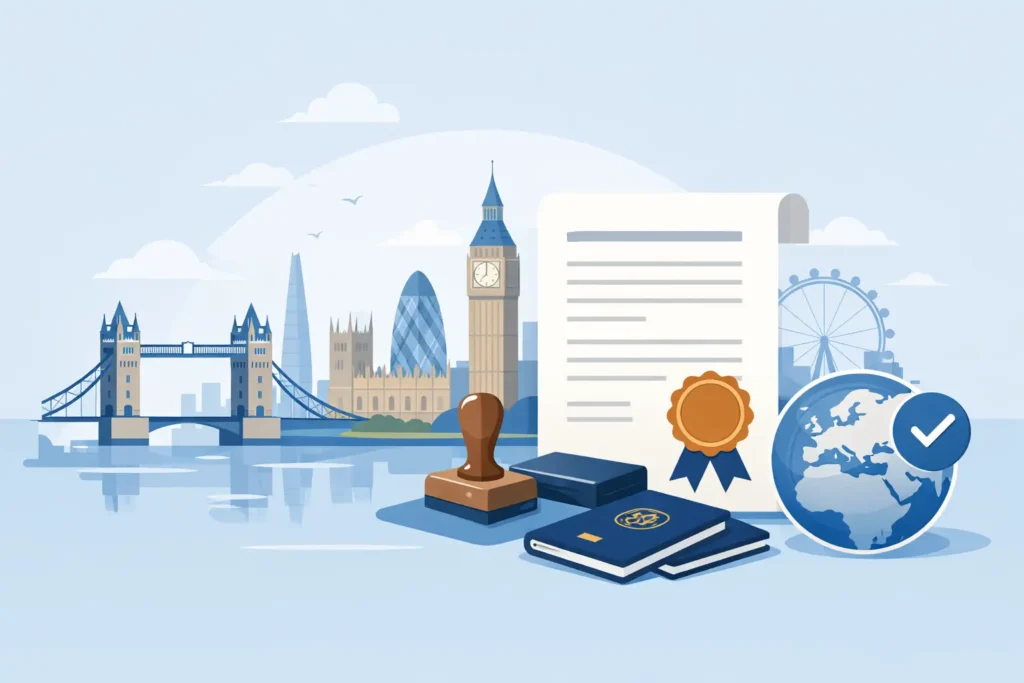
If you have been told your document needs an apostille in London, you are usually dealing with a time-sensitive matter. It may be a property sale overseas, a visa application, a marriage abroad, a company transaction, or probate involving assets in another country. In each case, the issue is not simply whether the document is genuine, but whether the receiving authority abroad will accept it.
That is where people often get stuck. The word itself is unfamiliar, different countries ask for different paperwork, and a rejected document can cost time, money, and in some cases a missed deadline. The good news is that the process is manageable when you understand what an apostille does and whether your document first needs notarisation or certification.
What an apostille means in London
An apostille is an official certificate attached to a UK document so that it can be recognised in another country that is part of the Hague Apostille Convention. In practical terms, it confirms the authenticity of the signature, seal, or stamp on the document. It does not approve the content of the document, and it does not replace legal advice on the transaction or application itself.
When clients ask for apostille London services, they are often referring to the full chain of work needed to prepare a document for use abroad. That may include checking the document, arranging notarisation, arranging solicitor certification where appropriate, and then submitting it for apostille. Not every document follows the same route, which is why assumptions can cause delay.
When you may need apostille London services
For individuals, apostilles are commonly required for birth certificates, marriage certificates, death certificates, powers of attorney, DBS certificates, degree certificates, and copies of passports. These documents may be needed for emigration, overseas employment, marriage abroad, dual nationality applications, school admissions, or dealing with estates and assets outside the UK.
For businesses, the usual documents include certificates of incorporation, articles of association, board resolutions, commercial contracts, certificates of good standing, and company powers of attorney. A business expanding into another jurisdiction may need corporate documents legalised quickly so that banking, registration, or contractual arrangements can proceed.
There is also an important distinction between countries. If the receiving country is part of the Hague Convention, an apostille may be enough. If it is not, further legalisation through that country’s embassy or consulate may be required after the apostille is issued. That is one reason a simple online checklist is not always enough.
Which documents can be apostilled
Some UK documents can be apostilled in their original form, while others need a preliminary step. Official documents issued by bodies such as the General Register Office or Companies House are often straightforward if they are the correct version. By contrast, private documents such as powers of attorney, declarations, translations, academic records, or signed letters often need to be notarised first.
This is where many people lose time. A scanned copy may not be acceptable. A printout of a certificate may not qualify. A foreign authority may ask for a certified copy when the original would have been better, or ask for a notarised translation in addition to the apostille. The right starting point depends on both the document and the country where it will be used.
Notarisation and apostille – the difference matters
Apostille and notarisation are related, but they are not the same thing. A notary public verifies identity, signatures, capacity, and in some cases the authenticity of the underlying document or transaction. The apostille then authenticates the notary’s signature or official signature so the document can be recognised abroad.
In simple terms, notarisation is often the first stage and apostille is often the second. But not always. Some documents do not need a notary because they are already official UK documents. Others must be notarised before they can move forward. If the sequence is wrong, the document may be rejected.
For example, a power of attorney for use overseas will frequently need careful drafting, execution in the correct form, and notarisation before apostille. A birth certificate, on the other hand, may only need the correct official copy. The process looks similar from the outside, but the legal preparation is different.
Common problems that delay apostille applications
Most delays come from avoidable issues rather than the apostille certificate itself. The most common problem is submitting the wrong type of document. Another is failing to check whether the receiving authority wants the original, a notarised copy, or a translation prepared in a particular way.
Names and dates also matter more than people expect. If a passport name differs from the name on a birth or marriage certificate, the receiving authority may ask for additional supporting evidence. Corporate clients can face similar issues if company details do not match current registration records.
There is also the question of timing. Some overseas authorities will only accept recently issued certificates. Others may require legalisation of a signature that was witnessed in a particular manner. If you are working to a property completion date, immigration appointment, or court deadline, these details are not minor.
How the apostille process usually works
The first step is to identify the document and the country where it will be used. That determines whether the document can go straight for apostille or whether it needs notarisation, certification, or translation first.
The second step is to make sure the document is in the correct form. That may mean obtaining a fresh official certificate, signing the document before a notary, or preparing a certified copy. If the document is to be translated, it is sensible to confirm whether the translation itself must also be notarised or apostilled.
The third step is submission for apostille. Once issued, the document may be ready for use, or it may need embassy legalisation if the destination country requires it. The overall timetable depends on the document type, the route required, and whether any additional stages are involved.
Apostille London for personal matters
For private clients, the process often sits alongside a major life event. You may be moving abroad, getting married overseas, dealing with an inheritance, or arranging care or property matters for a relative in another country. In those situations, legal documents are only one part of a larger pressure.
A practical, responsive approach matters. Clients usually want to know three things: what is actually required, how long it is likely to take, and what it is likely to cost. Clear advice at the outset can prevent repeated certification, unnecessary courier costs, and the frustration of a document being rejected overseas.
Apostille London for business documents
Commercial clients tend to be focused on speed, accuracy, and risk. A delayed apostille can affect contract execution, overseas company registration, banking arrangements, or the authority of a signatory acting abroad. If board minutes, powers of attorney, or corporate certificates are not prepared correctly, the issue can quickly move from administrative inconvenience to operational delay.
This is where a firm with both notarial and wider legal capability can add value. The document may not exist in the right form yet, or it may need review before execution. A narrow document-handling service may not spot the legal issue behind the paperwork.
Choosing the right support
The best support is not just about submitting papers quickly. It is about checking what the receiving authority actually needs and making sure the document is prepared correctly before time and money are spent on legalisation.
That is particularly important where documents relate to property, probate, immigration, family arrangements, or company authority. In those cases, the paperwork often sits within a wider legal matter, and getting one piece wrong can affect the rest. White Horse Solicitors & Notary Public works with both individuals and businesses who need documents prepared and legalised for use abroad, with the emphasis on clear advice, efficient handling, and practical next steps.
If you need an apostille, the safest starting point is not to guess. Check the destination country, check the type of document, and check whether notarisation comes first. A little care at the beginning usually saves far more effort later.
