
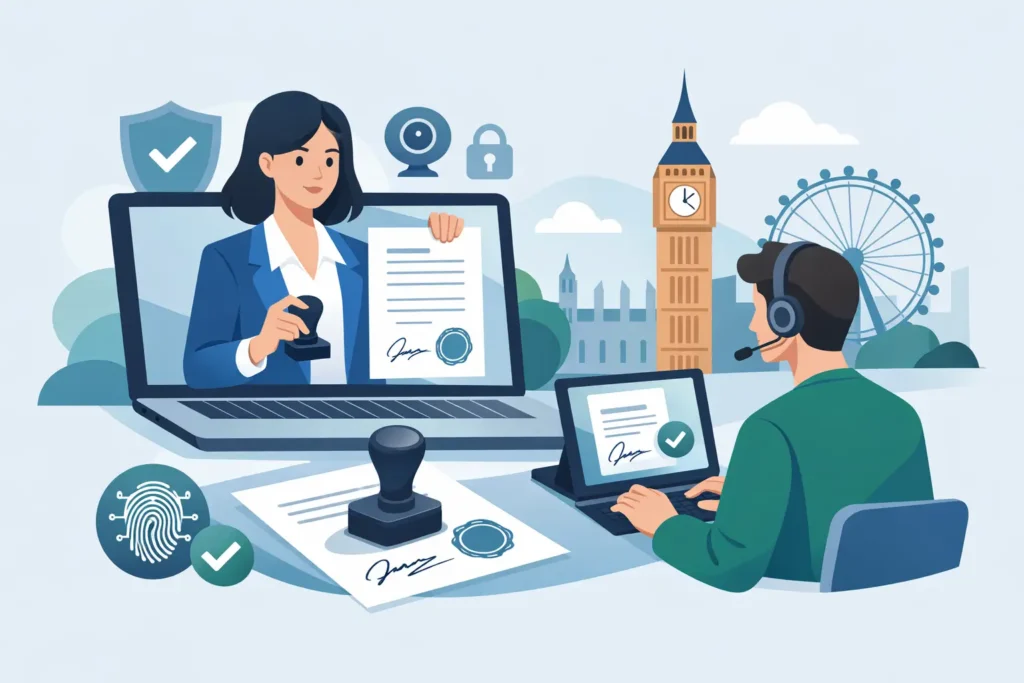
For clients dealing with overseas property, immigration, probate or company documents, the future of remote notarisation in the UK is a practical question rather than a passing technology trend. A video appointment and digital signing may appear quicker than travelling to a notary’s office, particularly where family members, directors or documents are in different countries. However, a document only helps if the overseas authority, bank, court or registry will accept it.
Remote notarisation has potential, but it is not a universal substitute for a face-to-face appointment. The legal formalities, the type of document and the country where it will be used all matter. For clients, the right question is not simply, “Can this be done online?” It is, “Will this form of notarisation be valid for its intended purpose?”
What remote notarisation means in practice
Remote notarisation usually refers to a notarial act carried out with some or all of the appointment taking place by secure video link. The client may provide identity documents electronically, sign using an approved electronic signature process, and receive a digitally signed notarial certificate. Depending on the circumstances, the original document may still need to be sent to the notary afterwards.
This is different from emailing a scanned signature or asking a professional to certify a copy without a proper appointment. Notarisation is a formal act. A notary must be satisfied about the client’s identity, legal capacity, understanding, authority to sign and, where relevant, the authenticity of the document. The notary must also keep a proper record of the work undertaken.
Technology can assist with those checks. It cannot remove the notary’s professional responsibility to make an independent assessment. That safeguard is especially significant where a document transfers property, grants a power of attorney, supports an overseas corporate transaction or will be relied upon in a foreign legal process.
Why demand is likely to grow
International documents are increasingly prepared, signed and exchanged digitally. A London business may have directors travelling overseas, shareholders in several jurisdictions and a transaction that cannot wait for everyone to be in the same room. An individual may need a power of attorney for a property abroad while caring for family in the UK, or require certified documents for a visa, marriage, inheritance or employment application.
For these clients, remote processes can reduce delay and make specialist notarial support more accessible. Video meetings can also be useful at the early stage: reviewing the document, explaining its effect, checking whether the signatory has authority and identifying what the receiving organisation requires before an appointment is arranged.
The development of e-Apostilles also points towards a more digital international document system. An Apostille confirms the authenticity of the signature and seal on a UK public document or notarial act for use in another Hague Convention country. An electronic Apostille can make the authentication stage more efficient, but it does not automatically mean that every underlying document can be notarised remotely. The notarisation, signing and acceptance requirements must still be addressed separately.
The legal and practical limits in England and Wales
The future of remote notarisation UK clients can rely on will depend on careful legal development, not convenience alone. England and Wales does not operate a single, blanket system that makes every notarial act suitable for video-based execution. The appropriate process depends on the document, the jurisdiction in which it will be used and the safeguards available to the notary.
Documents executed as deeds require particular care. Although electronic signatures can be valid in many circumstances, the witnessing formalities for deeds remain critical. A witness generally needs to be physically present when the individual signs. Watching via video link is not usually enough for a deed that requires attestation. Attempting to shortcut this stage can leave a client with a document that is ineffective or rejected at the point it is needed.
There are also documents that must be signed in wet ink because the receiving authority, overseas registry, bank or lawyer insists on an original. Some foreign jurisdictions have specific notarial wording, identity requirements or rules about the signatory appearing before a notary. Others may accept a digitally executed document in principle but reject a certificate created through a process unfamiliar to their local officials.
For that reason, a remote appointment should never be chosen solely because it appears faster. The intended recipient’s requirements should be checked first. This is often the most valuable step, particularly where a deadline is approaching.
Stronger identity checks will shape the next stage
The greatest challenge in remote notarisation is not the video platform. It is confidence. A notary needs reliable evidence that the person on screen is who they claim to be, understands the document and is acting freely.
Digital identity verification is likely to become more sophisticated. Secure document checks, biometric matching, fraud screening, audit trails, encrypted document storage and verified electronic signatures can all improve the process. Used properly, these measures can create a clearer record than an informal exchange of emails and scanned passports.
Yet digital checks have limits. A high-quality scan of a passport cannot, by itself, establish whether someone is being pressured to sign, whether they understand a complex power of attorney or whether a director has the authority claimed. A responsible remote process must allow the notary to ask questions directly, assess the circumstances and, where necessary, require a face-to-face meeting or additional evidence.
This is not an obstacle to progress. It is the reason remote notarisation can develop without weakening the protections clients and receiving authorities expect.
Acceptance abroad will remain decisive
Notarial documents are often intended for use outside the UK. That creates a further layer of risk: legal validity in England and Wales is not always the same as acceptance in the destination country.
A Spanish property authority, a UAE bank, an overseas probate court or a company registry may each have different requirements. They may ask for a wet-ink signature, an original notarial certificate, an Apostille, certified translations or specific wording. Some may be comfortable with electronic documents; others may not yet have the systems or policies to accept them.
Clients should therefore obtain clear requirements from the receiving organisation wherever possible. If a local lawyer is involved in the transaction, their confirmation can be particularly helpful. It is better to establish this before signing than to pay for a document that must later be redone.
A practical approach for clients and businesses
Remote options are most likely to work well where the document is suitable for electronic execution, the signatory can be verified securely and the recipient confirms it will accept the proposed format. They may be less suitable where a deed requires physical witnessing, an overseas authority insists on originals, the client is vulnerable, or there are concerns about capacity, undue influence or authority.
Before arranging notarisation, gather the final version of the document, evidence of identity and address, and any instructions issued by the overseas authority. Business clients should also have current company information and evidence that the person signing has authority, such as a board resolution where appropriate. Providing this material early allows the notary to identify the correct route and give clearer information about likely timescales and costs.
Where a remote route is not appropriate, an efficient in-person appointment may still be the quickest and safest option. A professional notary can prepare the wording, witness signing where permitted, certify supporting documents and advise whether Apostille or further legalisation is needed. The objective is not to force every matter into a digital process. It is to complete the matter correctly first time.
What the future is likely to look like
The direction of travel is towards more digital preparation, better identity technology and broader use of electronic authentication. Clients should expect more initial consultations by video, more secure document sharing and more streamlined Apostille processes. These developments can make international legal work more accessible and reduce avoidable delay.
At the same time, face-to-face notarisation will remain essential for many high-value, sensitive and internationally regulated documents. The strongest model is likely to be a hybrid one: digital where it improves speed and access, personal attendance where the law, risk profile or receiving authority demands it.
At White Horse Solicitors & Notary Public, the focus is on identifying the process that protects your document and meets the requirements of the country or organisation receiving it. If a remote route is available, it should be carefully verified. If an in-person appointment is needed, clear preparation can keep the process straightforward and give you confidence that your document is ready to be used.
