
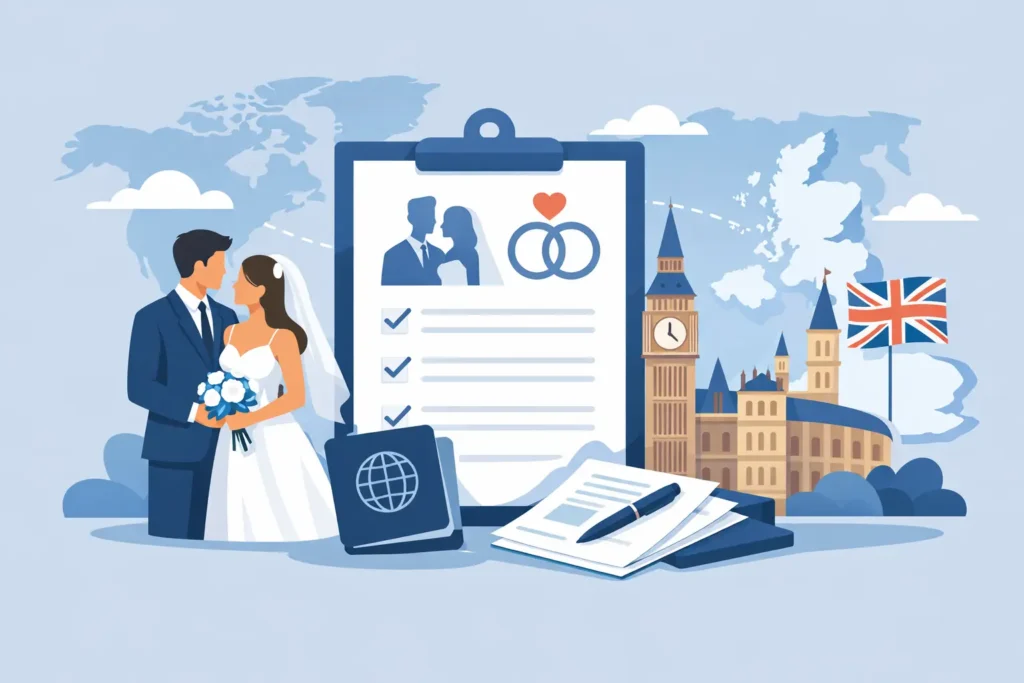
A marriage ceremony abroad can be one of life’s happiest events. The paperwork that follows can be less straightforward, particularly where a spouse is applying for a visa, buying property, changing a name or considering divorce. Many people ask about registering an overseas marriage in the UK records, expecting a local register office to add their foreign marriage certificate to a British register. In most cases, that is not how the system works.
The practical question is usually not whether you can register the marriage again in the UK. It is whether the marriage is legally recognised here, and what evidence a particular authority needs to accept it. The answer can affect your immigration application, financial arrangements and family law rights.
Can an overseas marriage be registered in the UK?
There is generally no routine process for registering a marriage that took place overseas with a register office in England and Wales. The marriage is recorded in the country where the ceremony took place, and the original certificate issued there remains the primary evidence of the marriage.
This does not mean that a valid overseas marriage is ignored in the UK. A marriage conducted abroad will often be recognised if it was valid under the law of the country where it took place and each person had legal capacity to marry. Legal capacity can involve issues such as age, previous marriages, divorce status and, in some cases, the law of the country in which a person was domiciled.
Scotland and Northern Ireland have their own legal systems and registration arrangements, but the central point remains similar: a foreign marriage is not normally copied into a UK marriage register simply because one or both spouses now live here.
A UK authority may nevertheless ask to see the certificate. That authority could be the Home Office, a solicitor, a lender, an employer, a pension provider, HM Revenue and Customs, a school, or an organisation handling an estate. Their concern is proving the marriage, rather than creating a new UK record of it.
When recognition of an overseas marriage needs closer review
Straightforward marriages performed in accordance with local rules are often accepted without difficulty. However, recognition is not automatic in every case. A careful review is sensible where the facts do not fit the usual pattern.
For example, additional advice may be needed if either spouse was under the legal age to marry, if a previous marriage had not been formally ended, or if the ceremony was a religious or customary ceremony with uncertain civil status. Proxy marriages, where one party was not physically present, can also require detailed consideration.
The position may be more complex for a potentially polygamous marriage, a marriage entered into under pressure or coercion, or a marriage involving a country whose records are difficult to verify. Same-sex marriages and civil partnerships may raise separate issues where the ceremony took place in a jurisdiction with different rules. These cases should not be approached on the assumption that a certificate alone settles every legal question.
Recognition can also matter for divorce. If you wish to start divorce proceedings in England and Wales following an overseas marriage, the court will need enough evidence that a legally valid marriage exists. Jurisdiction is a separate issue and may depend on where each spouse is living, their domicile and other connecting factors.
Proving a foreign marriage to UK authorities
For most purposes, the right documents are more useful than an attempt to register the marriage. Start by obtaining the official marriage certificate from the authority that registered the marriage abroad. If possible, obtain a full or long-form certificate rather than a ceremonial keepsake document.
Where the certificate is not in English, you will usually need a clear translation from a suitably qualified translator. The translation should identify the translator and confirm that it is an accurate translation of the original document. Some organisations have their own format requirements, so it is worth checking before paying for a translation.
You may also be asked for authentication. The correct route depends on the country that issued the certificate and the organisation requesting it. An apostille is commonly used to authenticate public documents between countries that participate in the Hague Apostille Convention. In other cases, further consular or diplomatic legalisation may be required.
These steps perform different functions. A translation makes the certificate understandable. An apostille or legalisation helps establish that the signature or seal on the public document is genuine. Neither process decides whether the marriage is recognised under UK law.
Keep the original certificate secure and use certified copies only where they are accepted. Certain applications, particularly immigration applications, may require the original document or a specified copy. A notary public may be able to certify copies or notarise supporting documents where appropriate, but notarisation is not a substitute for an apostille or for an official translation.
Overseas marriage registration in the UK for immigration purposes
A foreign marriage certificate is commonly used when applying for a spouse or partner visa. The Home Office will consider whether the relationship is genuine and subsisting, as well as whether the marriage is legally valid. The certificate is an important starting point, but it is rarely the only evidence required.
Supporting evidence might include proof that you live together, communicate regularly if living apart, share financial responsibilities or have made plans for your life in the UK. The appropriate documents depend on your circumstances. Submitting a large bundle of irrelevant material can be less helpful than providing clear, consistent evidence that addresses the relevant requirements.
If the certificate is translated, provide both the original-language document and the translation. Where the document has been legalised or apostilled, include that material as well. Names, dates of birth and places of birth should match the details in passports and application forms. Small discrepancies can cause delay, especially where transliteration from a non-Latin alphabet has produced alternative spellings.
A religious ceremony alone may not be enough for immigration purposes if it was not legally registered in the country where it occurred. In that situation, evidence of a recognised civil marriage may be necessary. If there is no civil registration, the couple may need advice on whether another immigration route is available and what proof of their relationship will be accepted.
Changing your name, buying property and dealing with finances
After marrying overseas, many people want to update their passport, driving licence, bank account or employment records. Each organisation sets its own identity and name-change requirements. Some will accept the foreign marriage certificate and translation; others may ask for authentication or additional evidence. It is sensible to check the requirement before sending an original certificate away.
Marriage can also affect property ownership and estate planning. If you are purchasing a home, the conveyancer will need to know your marital status and the names you intend to use on the title. Couples buying together should consider whether they will own as joint tenants or tenants in common. This decision can affect what happens to the property on death and whether a will is needed to reflect each person’s wishes.
For an existing will, marriage can have significant consequences. In England and Wales, marriage commonly revokes an earlier will unless it was made in contemplation of that particular marriage. An overseas marriage that is recognised here can therefore affect estate planning just as a UK marriage can. It is prudent to review your will, nominations and arrangements for jointly owned assets soon after marriage.
Avoid common document problems
Delays often arise because documents were prepared for the wrong purpose. A certificate accepted by a bank might not meet the standards required for a visa application or court proceedings. Ask the receiving organisation whether it needs the original certificate, a certified copy, a translation, an apostille, legalisation or a document issued within a particular period.
Do not assume that a certificate obtained through an unofficial intermediary will be accepted. Where replacement records are needed, request them from the civil registration authority or another recognised official source in the country of marriage. If documents have different spellings of names, gather the documents that explain the difference, such as passports, prior name-change records or birth certificates.
It is also unwise to arrange a second marriage ceremony in the UK merely because the overseas marriage has not been “registered”. A second legal marriage could create serious difficulties if the first marriage is already valid. If you would like a UK celebration, a non-legal blessing or celebration may be possible, but the legal position should be clear first.
When legal and notarial advice is worthwhile
Professional advice is particularly useful where an overseas marriage is connected with an immigration application, divorce, child arrangements, inheritance, property purchase, a disputed marital status or documents requiring overseas use. The required evidence and the order in which documents are authenticated can make a material difference to cost and timing.
White Horse Solicitors & Notary Public can help clients assess the legal position, prepare supporting evidence and identify whether family, immigration, property or notarial work is needed. Advice should be tailored to the country of marriage and the reason the documents are being used.
Before relying on an overseas marriage certificate for an important application, obtain the correct official version, check whether a translation or authentication is required, and deal with any inconsistencies early. A small amount of preparation can prevent a foreign marriage document becoming an avoidable obstacle at a crucial moment.
