
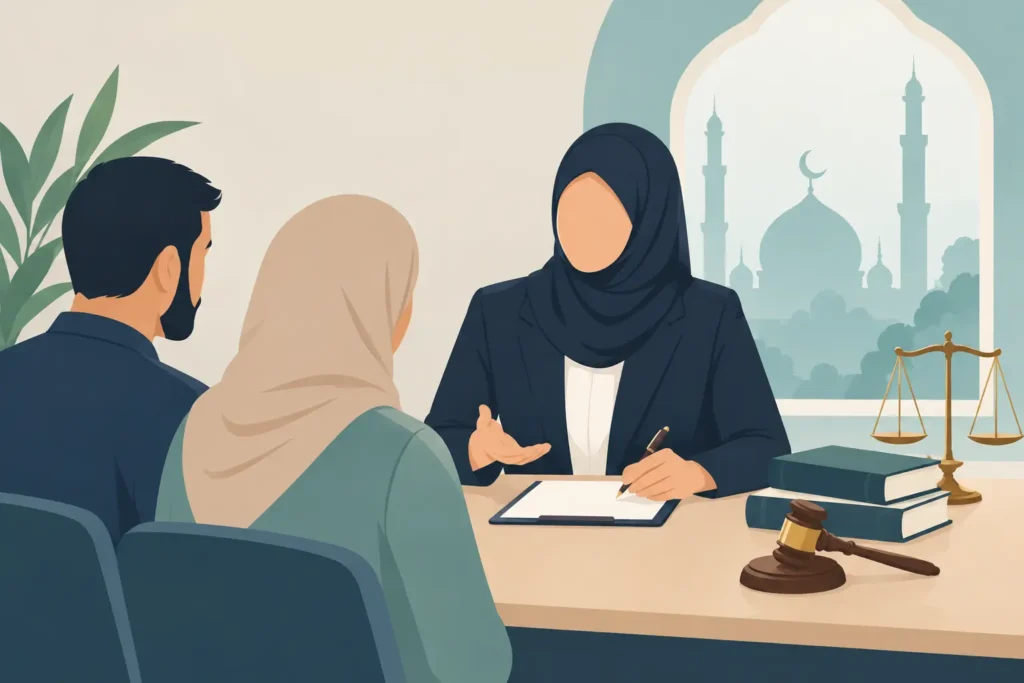
A marriage can end in two different ways: legally through the courts and religiously through the appropriate Islamic process. An Islamic divorce solicitor UK service helps ensure that neither side of this difficult situation is overlooked. For many couples, the priority is not simply obtaining a divorce, but reaching a fair outcome on children, the family home, savings and future financial security while also bringing religious matters to a proper close.
In England and Wales, a religious divorce and a civil divorce are separate matters. Treating one as if it automatically resolves the other can leave significant legal and personal issues outstanding.
Civil and Islamic divorce are not the same process
A civil divorce legally ends a marriage recognised under the law of England and Wales. It is dealt with through the Family Court and may involve separate arrangements concerning finances and children. Since the introduction of no-fault divorce, either spouse can apply without having to prove adultery, unreasonable behaviour or a period of separation.
An Islamic divorce may take a different form depending on the circumstances and the school of thought followed. It may involve talaq, khula, mubarat or a religious annulment or dissolution, sometimes referred to as faskh. The process is often considered by an imam, mosque, Shariah council or other recognised religious body.
A religious decision does not, by itself, end a civil marriage. Equally, a final civil divorce order does not necessarily mean that a person has obtained a religious divorce. This distinction can be particularly important where someone wishes to remarry in accordance with their faith, or where both spouses need clarity on their rights and responsibilities.
Was the Islamic marriage legally valid in England and Wales?
The answer can affect which legal options are available. Some couples have had a civil ceremony and an Islamic nikah. Others have had only a nikah, either in the UK or abroad. The legal position depends on the facts, including where the ceremony took place, whether legal formalities were met and whether the marriage is recognised here.
If there was a legally valid marriage, a civil divorce may be required to end it. The court can then deal with financial claims arising from the marriage, including pensions, property, maintenance and lump-sum payments.
Where a nikah was not a legally recognised marriage in England and Wales, the position can be more complex. A civil divorce may not be available, but that does not mean there are no legal remedies. There may still be issues involving jointly owned property, contributions to a home, child maintenance, arrangements for children, domestic abuse or immigration status. It is therefore unwise to assume that the absence of a marriage certificate ends the matter.
An experienced Islamic divorce solicitor in the UK can review the documents and circumstances at an early stage, explain whether a civil divorce is needed and identify the practical steps required.
Financial matters should be addressed properly
Ending the marriage is only one part of the process. A final divorce order does not automatically divide finances or prevent future financial claims. If there are assets, debts, pensions or property, it is usually sensible to seek a financial settlement and, where appropriate, a court-approved financial order.
This can be particularly important where one spouse has contributed to the family in ways that are not reflected by whose name appears on an account, title deed or business. Contributions may include paying household costs, caring for children, supporting a spouse’s career or funding improvements to a property.
Mahr is another issue that may arise. Its treatment under English law depends on how the agreement was made, its wording and the surrounding facts. It may be relevant to negotiations, but it should not be assumed that a religious agreement will automatically be enforced in the same way as a court order. Clear advice is needed before either party gives up a financial claim or agrees to terms that may not protect their position.
A negotiated settlement can save time, cost and distress where both parties are willing to engage constructively. However, agreement should be properly recorded. Informal promises, including those made during religious discussions, may not provide the certainty needed when property, pensions or future maintenance are at stake.
Children’s welfare comes first
Parents do not need to wait for a divorce to make arrangements for children. The central consideration for the court is the child’s welfare, not which parent applied for divorce or how the religious separation was handled.
Many parents can agree practical arrangements for where children live, time with each parent, school holidays, religious observance and communication. A clear written arrangement can reduce uncertainty, especially during an already emotional period.
If agreement cannot be reached, mediation may be suitable in some cases. Where this is not appropriate or does not resolve the issue, an application to the Family Court may be necessary. The court can make child arrangements orders and, in limited circumstances, specific issue or prohibited steps orders.
Child maintenance is separate from contact arrangements. A parent should not withhold time with a child because maintenance has not been paid, nor stop maintenance because contact is disputed. Both issues should be dealt with through the correct process.
When safety or control is a concern
Divorce can bring existing tensions to the surface. If there is domestic abuse, coercive control, threats, financial restriction or concern for a child’s safety, obtaining urgent legal advice is essential. Religious expectations must never be used to pressure someone into remaining in an unsafe relationship or accepting an unfair outcome.
Protective options can include non-molestation orders and occupation orders, depending on the circumstances. Emergency support may also be available through the police, local authority services and specialist domestic abuse organisations. If there is immediate danger, contact the emergency services.
A solicitor should handle these situations with sensitivity and confidentiality. In some cases, it may be appropriate to progress civil proceedings without direct negotiation between the parties.
What an Islamic divorce solicitor UK service can do
The right legal support is not about replacing religious guidance. A solicitor is not a religious authority and cannot issue an Islamic divorce. Their role is to protect your legal position and help coordinate the civil issues alongside the religious process.
This may include advising on the validity of the marriage, preparing or responding to a divorce application, negotiating financial terms, dealing with property and pensions, advising on child arrangements, and obtaining protective court orders where necessary. It can also involve explaining how a religious divorce process sits alongside English family law, so that decisions made in one process do not unintentionally damage your position in the other.
For clients who have international connections, additional care may be needed. A divorce, talaq or court decision obtained abroad may have different consequences in England and Wales. Questions of recognition, jurisdiction, overseas assets and immigration status should be considered before documents are signed or proceedings are started in another country.
Choosing legal support with confidence
When speaking with a solicitor, it helps to ask whether they regularly deal with family finances, child arrangements and cases involving Islamic marriages or religious divorce. You should also ask how fees will be charged, whether a fixed fee is available for part of the work and what information is needed for an initial assessment.
Bring any marriage certificates, nikah documentation, correspondence from a mosque or Shariah council, financial records, property documents and details of children’s arrangements. Even where documents are incomplete, early advice can help prevent delays and ensure that important evidence is preserved.
White Horse Solicitors & Notary Public provides practical family law advice with an understanding that legal, financial and religious concerns can all matter deeply to a client. The aim is to give clear advice, protect what needs protecting and help you move forward with greater certainty.
The most helpful first step is often simply to establish where you stand legally before making commitments in either the civil or religious process. That clarity can make a painful transition more manageable and give you a sound basis for the decisions ahead.
