
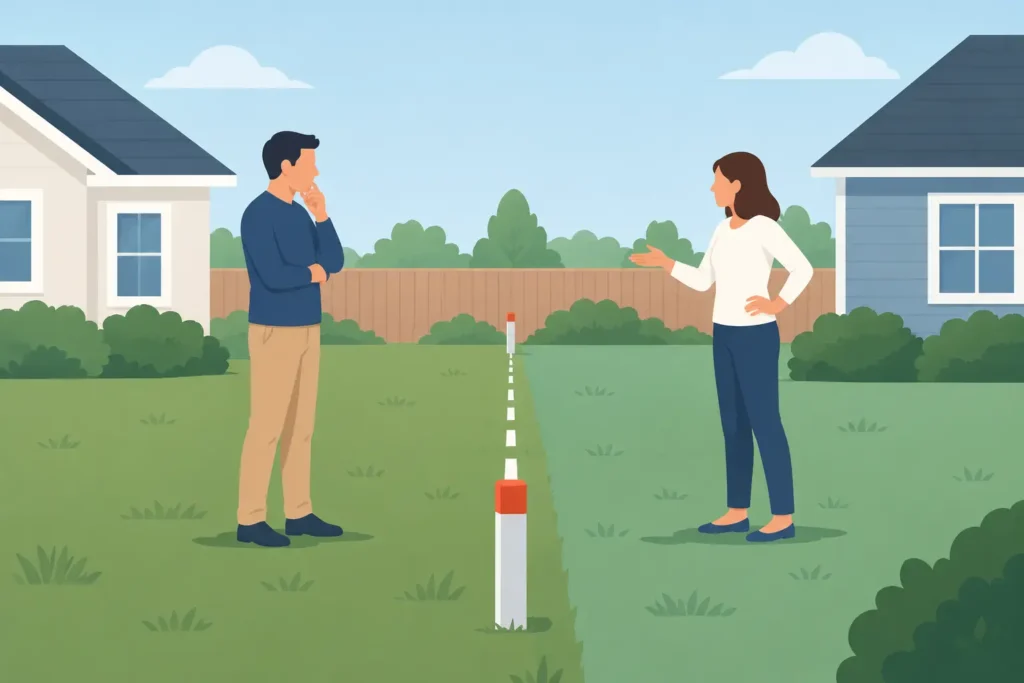
A fence moved by a few inches can feel like a minor irritation. But where it affects access, parking, development plans, privacy or the value of a property, it can quickly become a serious neighbour dispute. This boundary dispute guide sets out the practical steps property owners in England and Wales can take to understand their position and seek a sensible resolution.
Boundary disputes are rarely just about a line on the ground. They often involve historic use, incomplete documents, unclear plans and strongly held views on both sides. Acting carefully at the outset can preserve evidence, reduce expense and give settlement the best chance of success.
What counts as a boundary dispute?
A boundary dispute arises when neighbours disagree about where the legal boundary between their properties lies, or what each owner may do near it. The issue might concern a fence, wall, hedge, driveway, path, parking area, drain or access route.
Some disagreements concern the position of the boundary itself. Others concern rights connected with it, such as whether a neighbour can use a shared passageway, maintain a wall, cut back overhanging branches or build close to the dividing line. These issues can overlap, but the legal questions are different.
The central point is that the Land Registry title plan will not usually provide an exact answer on its own. Most registered title plans show what is known as a general boundary. The red edging identifies the general extent of the registered land, not a precise line measured to the centimetre. This is a common source of misunderstanding.
Start with the documents and the ground
Before writing a confrontational letter or arranging work, gather the available information. Your title register and title plan are a useful starting point, particularly where the register refers to rights, covenants or historic conveyances. Older deeds may contain more detailed plans, written dimensions or descriptions of boundary features.
It is also sensible to look at the property as it is now and how it has appeared over time. Useful evidence can include dated photographs, estate agent particulars, planning documents, aerial imagery, invoices for fencing or landscaping, and correspondence with previous owners. Long-standing physical features, such as a brick wall or established hedge, may be relevant, although they do not automatically prove ownership or the legal boundary position.
Speak to former owners where this is practical. They may be able to explain when a fence was installed, whether an area was shared, or whether a previous agreement was reached. Their recollection should be recorded promptly, as memories can fade and informal arrangements are easily misunderstood later.
Do not rely on assumptions about fences and hedges
A common belief is that a homeowner owns the fence on the left or right when facing the property from the road. There is no general legal rule to that effect. Similarly, a ‘T mark’ on a plan can sometimes indicate responsibility for a boundary feature, but its meaning depends on the relevant document and cannot be interpreted in isolation.
Responsibility for maintaining a boundary feature is also not the same as ownership of the land beneath it. A fence standing on one side of a boundary may be maintained by one neighbour while the legal boundary lies elsewhere. These distinctions matter if either party wants to replace a structure, build an extension or claim that land has been occupied for many years.
Avoid removing a fence, hedge or wall simply because you believe it is in the wrong place. Doing so may worsen relations, create a claim for damage, or make a later legal assessment more difficult. If urgent work is necessary for safety, take photographs first and obtain advice on how to proceed.
A practical boundary dispute guide: take proportionate steps
Not every boundary issue needs formal proceedings. The value of the land in question may be modest, while the legal costs and stress of a contested case can be substantial. A proportionate approach is usually the best starting point.
Begin with a calm conversation if it is safe and appropriate to do so. Explain the concern, share the documents you have found and ask your neighbour what evidence they rely on. The aim is not to concede your position, but to establish whether there is a genuine misunderstanding that can be resolved without escalation.
If direct discussion is not productive, written communication can help clarify matters. Keep it factual and measured. Set out the issue, identify the relevant documents, explain the practical effect on your property and suggest a way forward. Avoid accusations, threats or statements that you cannot substantiate.
Where the boundary cannot be established from the paperwork and physical features alone, a specialist land surveyor may be able to prepare an expert report. This can involve inspecting the site, analysing historic plans and applying established boundary principles. Surveyor input has a cost, so it is most useful where the disputed area or proposed works justify the expense.
Mediation is another option. It allows both parties to discuss practical solutions with the assistance of an independent mediator. A settlement might involve agreeing a fence position, granting a small right of access, sharing maintenance responsibilities or paying a contribution towards works. A negotiated agreement can be faster and less damaging to neighbour relations than a tribunal or court dispute.
Formalising an agreement
An informal understanding may work while the same neighbours remain in place, but it can cause problems when either property is sold. If you reach agreement, consider recording it properly.
Depending on the circumstances, this may involve a boundary agreement, a transfer of a small strip of land, or an application to register a determined boundary. A determined boundary is more precise than the usual general boundary shown on a title plan. It requires carefully prepared plans and supporting evidence, and it may be challenged by the adjoining owner.
The right solution depends on the facts. A simple written agreement may be enough for a low-risk issue, whereas a proposed extension, sale or development may justify more formal documentation. Legal advice can help ensure the arrangement reflects what was agreed and is capable of protecting future owners.
When legal action may be necessary
Formal action should normally be a last resort, but it may be necessary where a neighbour has built on your land, blocked access, threatens to remove a structure, or refuses to engage despite clear evidence. A solicitor can review the title documents, correspondence and surveyor evidence, advise on the merits of the case and communicate with the other party in an appropriate way.
Some property boundary matters are dealt with through the Land Registry process, while others may need to proceed in the First-tier Tribunal or the County Court. The correct route depends on what is being disputed and what remedy is sought. These cases can become expensive, particularly if expert evidence and hearings are required, so the strengths and commercial value of the claim should be assessed honestly from the start.
There may also be time-sensitive concerns. For example, long occupation of land can raise issues around adverse possession, while planned building works may require urgent steps to prevent irreversible change. Early advice is particularly valuable where a sale, remortgage, extension or commercial transaction is affected.
Keep the dispute from affecting your next move
A boundary dispute can need to be disclosed when selling a property. Even where a disagreement has been settled, buyers may ask about its history and supporting documents. Keeping a clear record of communications, evidence and any agreement will make this process more manageable.
The same is true for landlords and business owners. A contested boundary can affect access, tenant use, insurance, development proposals and the marketability of commercial premises. The practical impact should be considered alongside the legal position.
A clear boundary is valuable, but so is a proportionate solution. Where the facts are disputed or the stakes are high, obtaining early property law advice can help you protect your position without allowing a few inches of land to become an avoidable and expensive conflict.
