
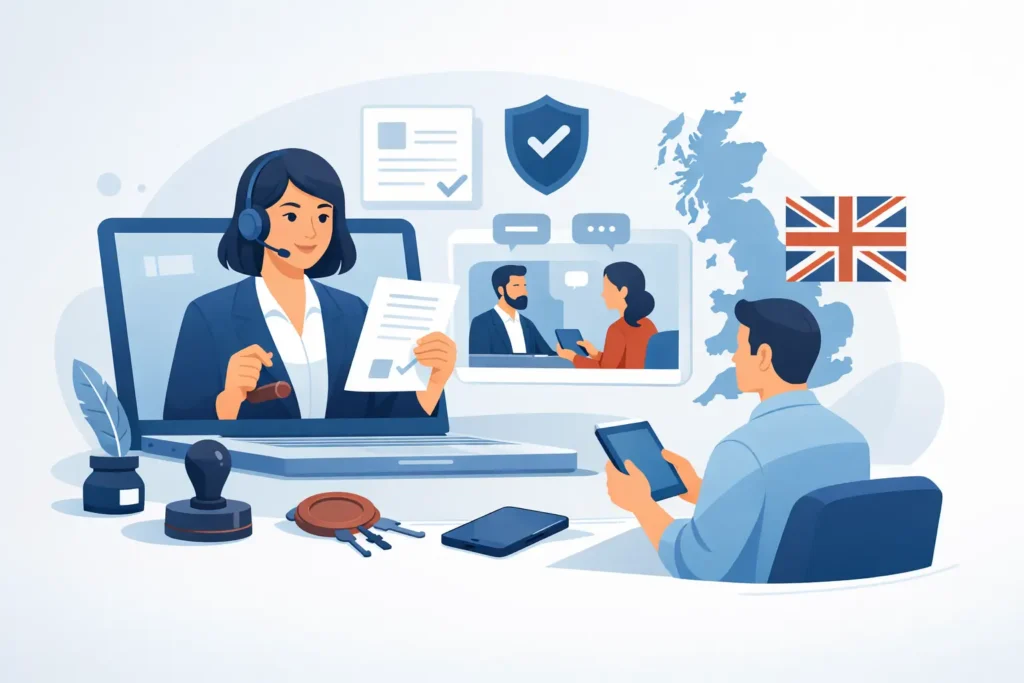
A document for use overseas often becomes urgent at the worst possible moment. You may be travelling, working abroad, managing a property sale, dealing with probate, or trying to satisfy a foreign authority on a tight deadline. In that situation, many people start searching for a remote notary and assume the whole process can be completed online. Sometimes that is possible in part, but the real position in the UK is more careful than many websites suggest.
What a remote notary usually means
When clients ask about a remote notary, they are usually asking whether identity checks, document review, witnessing and certification can all be handled without attending an office. The answer depends on the type of document, the country where it will be used, and the rules that apply to the notary.
A notary public is not simply witnessing a signature in the ordinary sense. A notary is certifying identity, capacity, authenticity and, in some cases, the proper execution of a document for use in another jurisdiction. Because overseas authorities rely on that certification, the process must be handled with care. If a document is rejected abroad, the cost is not only financial. It can delay a transaction, an immigration application, a property matter or the release of funds.
That is why the phrase remote notary can be misleading. It suggests a single, fully digital process that works in every case. In practice, some parts of the process may be carried out remotely, while other parts may still require original documents, wet-ink signatures or in-person verification.
Is remote notary accepted in the UK?
This is where clients need a practical answer rather than a broad promise. In the UK, notarial work is governed by professional rules and by the requirements of the receiving authority. Even if remote methods are technically available, the key question is whether the document will be accepted by the organisation or public body abroad.
For example, a company may accept a digitally handled document for an internal compliance purpose, while a foreign land registry, court, bank or consulate may insist on more formal execution. Some jurisdictions are comfortable with electronic processes. Others still expect original signed documents, notarised in a traditional way and then legalised or apostilled if required.
So, can a remote notary help? Often yes, to a degree. Initial document review, discussions about requirements, collection of ID evidence and some preparatory steps may be handled remotely. Whether the final notarisation itself can be completed without a face-to-face meeting is a separate question and should be checked before anything is signed.
When a remote notary may be suitable
Remote arrangements are most useful where the issue is speed, distance or convenience, but the legal and practical requirements still allow it. A client based outside London may want advice on a power of attorney for use abroad. A business director may need certified copies of identity documents for an overseas transaction. An individual dealing with foreign inheritance may need guidance on affidavits or declarations before attending for the final stage.
In these cases, remote preparation can save time. Documents can be reviewed in advance, likely problems can be identified early, and clients can be told what originals to bring or post. That matters because many delays happen not during notarisation itself, but beforehand – when names do not match passports, supporting evidence is incomplete, or the receiving country has additional formalities that were not identified at the start.
The most efficient service is not always the one that is entirely online. It is the one that gets the document accepted first time.
When remote notary services may not be enough
There are situations where a fully remote route is unrealistic or unwise. If the document involves a high-value property transaction abroad, a company matter requiring board authority, a document signed under pressure, or a person whose identity or capacity needs closer assessment, a notary may reasonably require an in-person appointment.
The same applies where the receiving authority is known to be strict. Certain embassies, registries and foreign legal systems apply formal requirements rigidly. If they expect original paperwork, a physical seal, and conventional execution, trying to force a digital shortcut can create more delay than it saves.
There is also a difference between what is legally possible and what is commercially sensible. If a client has a completion date, a visa deadline or an estate administration issue abroad, certainty matters more than novelty. A cautious process is often the better process.
What your notary will usually need
Whether the matter begins remotely or in person, the same core checks still apply. A notary will usually need proof of identity, proof of address and the document itself in final form or near-final form. Depending on the matter, they may also need evidence explaining the purpose of the document, details of the receiving country, and any instructions from the foreign lawyer, bank, court or authority requesting it.
For company documents, additional evidence is often required. That may include Companies House records, board minutes, signing authority, constitutional documents or evidence that the transaction is genuine and properly approved. For powers of attorney, declarations or consent documents, the notary may need to be satisfied that the signer understands the effect of what they are signing.
This is one reason notarial work should not be treated as a box-ticking exercise. The notary is expected to apply judgement, not merely stamp paperwork.
Remote notary and apostille requirements
Many clients searching for a remote notary are really trying to solve a wider international documentation issue. Notarisation is often only one stage. After that, the document may need an apostille or further legalisation, depending on the destination country.
That distinction matters. A document can be properly notarised but still not ready for use abroad. Equally, a client may focus on the apostille and overlook the fact that the underlying notarisation was incomplete or carried out in a form the receiving authority will not accept.
If the document is going overseas, it is sensible to check the whole chain from the start: what form the document must take, whether notarisation is required, whether an apostille is needed, and whether translation or consular legalisation will follow. The right process at the beginning usually prevents expensive corrections later.
Choosing a remote notary service carefully
The safest approach is to look for clarity, not marketing claims. If a provider suggests that every document can be notarised entirely online without qualification, that should prompt questions. The more responsible answer is usually more measured.
A good notarial service will ask where the document is going, what it is for, who will receive it, and whether any specific wording or formalities have been requested. It will also explain what can be done remotely, what may need an appointment, and what the likely costs and timescales are.
That practical approach is especially important for clients juggling several legal issues at once. Someone dealing with an overseas property sale may also need independent legal advice, identity verification, certified copies or immigration-related supporting documents. A service that understands the wider legal context can save time and reduce avoidable stress. This is one reason many clients prefer a full-service firm such as White Horse Solicitors & Notary Public, where notarial work sits alongside broader legal support.
Common misunderstandings about remote notary services
One common misunderstanding is that a video call alone makes a document valid internationally. It does not. Validity depends on the legal status of the document, the authority of the notary, the way the document is executed, and the receiving country’s requirements.
Another is that a solicitor and a notary perform the same role. Some solicitors are also notaries, but the functions are different. If a foreign authority has asked for notarisation, a standard witnessing or certification by a solicitor may not be enough.
Clients also sometimes assume that if one country accepted a remote process before, another country will do the same. International document requirements are rarely that simple. The answer often changes from one jurisdiction to another, and sometimes from one institution to another within the same country.
A practical way to approach your matter
If you think you need a remote notary, start by gathering the document, your ID, your proof of address and any message from the overseas authority requesting the notarisation. If you know the receiving country and the deadline, provide those details at the outset. If you have not yet signed the document, do not sign it until you have been told whether that is appropriate.
That small step can make a significant difference. In notarial matters, the fastest route is usually the one that begins with the right questions. If your document can be prepared remotely and completed efficiently, that should be made clear. If an in-person stage is necessary, it is better to know that early than after a rejected submission.
When documents are being used abroad, confidence comes from doing the job properly rather than doing it hurriedly. A careful notarial process gives you the best chance of your document being accepted without further complication.
