
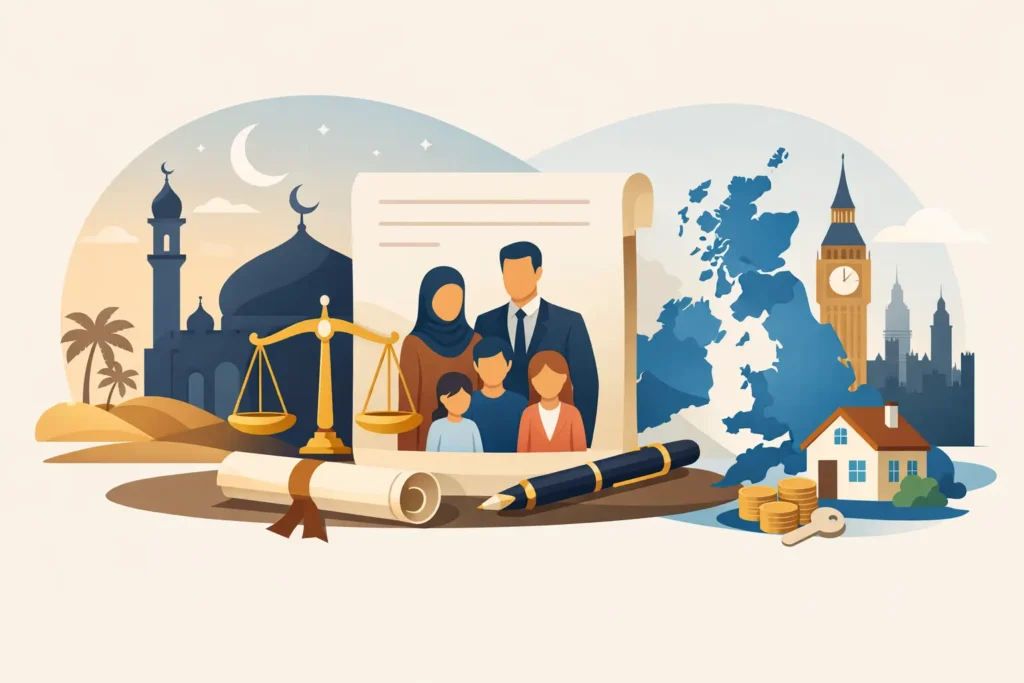
If you want your estate to be distributed in line with Islamic principles, a sharia compliant will UK document needs more than good intentions. It must reflect your religious wishes while also meeting the legal rules that make a will valid in England and Wales. If either side is overlooked, your family may face delay, uncertainty, or disputes at a time when they most need clarity.
For many people, the concern is not simply who receives what. It is whether their final affairs will be handled properly, whether debts and funeral expenses will be addressed, and whether their loved ones will have clear legal authority to deal with banks, property, and probate. A will drafted with both Shariah principles and UK legal requirements in mind can help provide that certainty.
What is a sharia compliant will in the UK?
A sharia compliant will in the UK is a will drafted to reflect Islamic inheritance principles, while still complying with the law of the jurisdiction where it will be used. In England and Wales, that means the will must satisfy the formal legal requirements for validity, including proper drafting, signing, and witnessing.
This is where some people get caught out. A document may express Islamic wishes but still fail as a legal will if it has not been prepared and executed correctly. Equally, a standard will may be legally valid but fail to reflect the inheritance structure the person intended under Islamic principles.
A carefully drafted will usually addresses both. It records the person’s intentions clearly, appoints executors, deals with practical estate administration, and sets out gifts in a way that works within the legal framework.
Why a standard will may not be enough
Many off-the-shelf wills are designed for straightforward distribution between a spouse and children, often with broad wording such as leaving everything equally or passing the estate entirely to a surviving husband or wife. That may not match the inheritance shares a Muslim testator wants applied.
There are also wider issues. Some people want to include provisions relating to burial wishes, charitable giving, repayment of Islamic debts, or assets held under Islamic finance arrangements. Others may have family structures that need careful treatment, such as children from different marriages, overseas property, or relatives who depend on them financially.
A standard form rarely deals with these points properly. More importantly, where wording is vague, executors can be left with difficult questions about interpretation. Probate becomes harder, and family disagreement becomes more likely.
How English law and Islamic inheritance fit together
This is the point where clear advice matters. English law gives individuals a significant degree of testamentary freedom, meaning you can generally decide how your estate will be distributed by will. That flexibility allows many people to prepare a will that reflects Islamic inheritance principles.
However, there are limits and practical complications. Certain claims can still be brought against an estate, particularly by dependants or close family members who believe reasonable financial provision has not been made for them. So while a will may be drafted to follow Shariah principles, it is not immune from challenge simply because it reflects religious intentions.
The position may also differ depending on where assets are located. Property in another country may be subject to local succession rules. If you own assets in more than one jurisdiction, a single UK will may not be enough on its own, or it may need to be carefully coordinated with separate foreign wills.
That is why this area is rarely just about inserting Islamic shares into a template. It is about making sure the document works in real legal and practical terms.
Key issues a sharia compliant will UK should address
A properly prepared sharia compliant will UK should do more than divide the estate. It should also deal with the administration of the estate in a way that reduces uncertainty.
The appointment of executors is one of the most important parts. These are the people responsible for collecting assets, paying debts and tax, applying for probate, and distributing the estate. Choosing suitable executors matters, particularly where the estate includes property, business interests, or international elements.
The will should also identify the assets and intended beneficiaries with enough precision to avoid confusion. If a person wants a portion of their estate to be given as charitable donation, that should be expressed clearly. If they wish to provide guidance on funeral arrangements consistent with Islamic practice, that can also be included, although families should understand that practical arrangements often need to be made quickly after death.
Another important point is guardianship. If you have minor children, your will is often the right place to appoint guardians. For many parents, this is just as important as inheritance planning.
The one-third rule and fixed shares
In many Islamic inheritance discussions, people refer to the ability to leave up to one-third of the estate by will, with the remainder passing according to fixed shares under Islamic principles. In practice, this area needs careful legal drafting rather than assumptions.
The estate available for distribution is not simply the gross value of everything you own. Debts, funeral expenses, tax, and administration costs will usually need to be settled first. The nature of the assets matters too. Jointly owned property, pension benefits, trust assets, and nominated accounts do not always pass under a will in the same way as solely owned assets.
This is why home ownership deserves particular attention. If a property is owned jointly, the way it is held can affect whether your share passes under your will at all. Many people assume their will controls the family home, when legally that may not be the case unless the ownership structure has been reviewed.
Common mistakes to avoid
One common mistake is relying on a homemade will or a document copied from an online source. A will may look clear to the person making it, but poor wording can create serious problems after death. Where religious intentions and legal rules intersect, loose drafting is especially risky.
Another mistake is failing to keep the will up to date. Marriage, divorce, the birth of children, buying property, or acquiring assets abroad can all affect whether the will still works as intended. A will that made sense five years ago may now leave major gaps.
Some people also forget that lifetime arrangements can affect the estate. Gifts made before death, jointly held funds, business structures, and debts owed within the family can all influence what is actually available for distribution. If these matters are ignored when the will is prepared, the final outcome may differ sharply from what was intended.
Finally, there is the issue of execution. Even a well-drafted will can fail if it is not signed and witnessed correctly. That is a basic legal point, but it still causes avoidable problems.
When specialist legal advice is especially important
Not every estate is complex, but some situations call for particular care. If you own property in the UK and abroad, run a business, have a blended family, expect the possibility of a claim against the estate, or hold assets through Islamic finance arrangements, specialist advice is sensible.
It is also important where there may be tension between family expectations and the legal realities of estate administration. Clear advice during your lifetime can prevent misunderstanding later. In our experience, much of the value of proper will drafting lies in avoiding future conflict rather than simply producing the document itself.
A solicitor can also help ensure your will fits with the rest of your planning. That may include reviewing title to property, considering inheritance tax exposure, and checking whether any accompanying documents are needed, such as lasting powers of attorney.
How the process usually works
The process is often more straightforward than clients expect. It usually starts with gathering information about your family, assets, liabilities, and priorities. From there, the drafting needs to reflect both the legal framework and your religious intentions.
At that stage, the detail matters. How assets are owned, whether there are overseas connections, whether any beneficiaries are vulnerable, and who is best placed to act as executor all need to be considered. Once the draft is approved, the will must be signed and witnessed properly to make it legally valid.
For many clients, the real benefit is peace of mind. They know their family will have a document that is legally usable and tailored to their wishes, rather than a generic form that leaves difficult questions unanswered.
White Horse Solicitors & Notary Public advises clients on wills and estate planning with a practical, client-focused approach, including matters where Islamic considerations need to be addressed carefully within the law of England and Wales.
A will that works for your faith and your family
A sharia compliant will UK arrangement is not just about compliance in the abstract. It is about making life easier for the people you leave behind, reducing the scope for disagreement, and ensuring your estate is dealt with in a legally effective way.
If your wishes matter to you, they are worth recording properly. A carefully prepared will gives your family clearer direction, stronger legal footing, and one less burden to carry when the time comes.
