
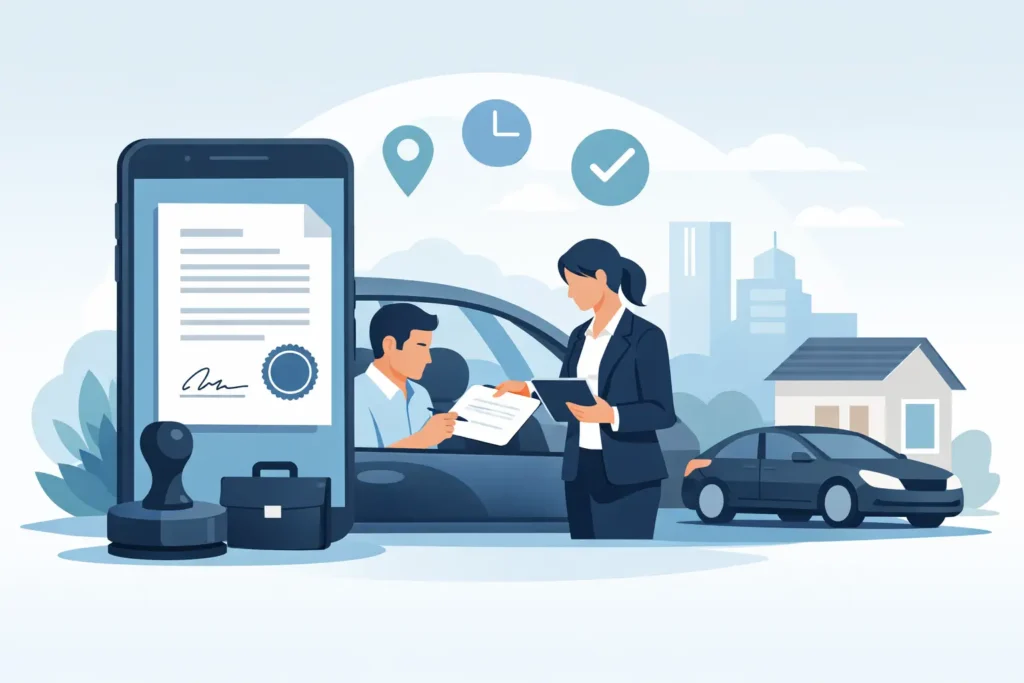
When a document needs to be notarised, timing is often the real problem. You may be preparing papers for a property sale overseas, authorising a power of attorney for a relative, or dealing with company documents that cannot wait for a convenient office appointment. That is where mobile notarisation can be particularly useful.
Mobile notarisation means a notary public attends a location that suits you, rather than asking you to travel to the notary’s office. For many clients, that is less about convenience in the casual sense and more about solving a practical difficulty. You may be at work all day, caring for a family member, recovering in hospital, or managing a transaction with urgent international deadlines.
What mobile notarisation actually involves
At its core, the process is still a formal notarial appointment. The notary must verify identity, assess whether the signer understands the document, check that the document is suitable for notarisation, and ensure the signing is properly witnessed where required. The fact that the appointment happens at your home, office or another agreed location does not reduce the legal care involved.
That point matters because clients sometimes assume a mobile service is simply a signature collection exercise. It is not. A notary public is carrying out a regulated legal function, and the same professional standards apply whether the meeting takes place in an office boardroom or at a client’s kitchen table.
In practice, the appointment often begins with a review of the documents in advance. That helps identify whether the paperwork is complete, whether identification documents are acceptable, and whether any supporting evidence will be needed. If the receiving country requires further steps, such as legalisation or an apostille, those issues should be considered early rather than after the document has been signed.
When mobile notarisation makes sense
Mobile notarisation is especially helpful when attendance at an office is difficult, impractical or commercially disruptive. Individuals often use it when they are elderly, unwell, travelling on a tight schedule, or managing family obligations that make it hard to attend in person during working hours.
For businesses, the value is often speed and efficiency. A director may need to sign corporate documents before an overseas filing deadline. A property matter may involve several signatories in different locations. Senior staff may need documents dealt with on site so that the transaction keeps moving without losing half a day to travel and waiting time.
There are also situations where sensitivity matters. If someone is signing documents in hospital or as part of a difficult family or probate issue, arranging attendance at a suitable location can remove unnecessary strain. The legal requirements remain the same, but the service is delivered in a way that is more practical and humane.
Documents commonly handled through mobile notarisation
A wide range of documents can be notarised on a mobile basis, provided the circumstances are suitable. Common examples include powers of attorney, affidavits, statutory declarations, certified copy documents, company resolutions, overseas property documents, parental consent documents, and paperwork required for immigration or international business transactions.
That said, suitability depends on more than the document title. The notary will need to consider who is signing, what the receiving authority requires, whether witnesses are needed, and whether the signer has legal capacity. Some matters are straightforward. Others need careful preparation before any appointment is booked.
What you will usually need to provide
Most notarial appointments require reliable proof of identity and proof of address. In many cases, that means a current passport and a recent utility bill or bank statement. If the document relates to a company, further evidence may also be needed, such as Companies House records, board minutes, or proof of the signer’s authority to act for the business.
The notary may also need to know where the document is going and why it is required. This is not unnecessary formality. Different countries and organisations have different expectations, and a document prepared incorrectly can be rejected abroad, causing delay and extra cost.
If the document is not in English, that does not always prevent notarisation, but it can create additional issues. The notary must be satisfied as to what is being signed and whether the signer understands it. Sometimes a translation or further explanation will be required.
Mobile notarisation and remote notarisation are not the same
Clients sometimes use these terms interchangeably, but they are different. Mobile notarisation usually means the notary travels to meet the client in person. Remote notarisation suggests the process takes place by video or through an online platform.
That distinction is important because notarial rules in England and Wales are strict, and not every document can be dealt with remotely. Even where some aspects of document handling are done electronically, many matters still require physical attendance, original identification, wet-ink signatures, or specific certification language for use overseas.
For that reason, clients should not assume that because a receiving organisation has mentioned an online process, the UK notarial requirements will automatically match it. It is always better to confirm the exact destination requirements before proceeding.
The practical advantages – and the trade-offs
The obvious advantage of mobile notarisation is convenience, but that is only part of the picture. It can save valuable time, reduce disruption to business operations, and make legal formalities manageable for people who would otherwise struggle to attend an appointment. In urgent cases, it can also help keep an international transaction on track.
The trade-off is that a mobile appointment may cost more than an office meeting. Travel time, scheduling constraints and location all affect fees. If the matter is complex or outside normal hours, that can also influence pricing.
There is also a practical limit to what can be fixed on the spot. If your identification is incomplete, the document is unsigned where it should have been pre-signed, or the overseas authority’s requirements are unclear, the notary may need to pause the process until those points are resolved. Mobile service is flexible, but it does not remove the need for proper preparation.
How to prepare for a mobile notarisation appointment
A little planning usually makes the appointment quicker and avoids repeat visits. Send copies of the documents in advance where possible. Confirm exactly which documents need notarising and whether any witnesses are required. Have your original identification ready, not just copies on a mobile phone.
If the signing is taking place at a business premises, make sure the relevant person is available at the agreed time and has authority to sign. If the matter involves an elderly or unwell signer, tell the notary beforehand so enough time can be allowed and any concerns about capacity can be addressed appropriately.
It is also sensible not to sign documents in advance unless you have been told to do so. Many notarial acts require the signature to be witnessed by the notary. Signing too early can create avoidable problems.
Choosing the right notary for mobile notarisation
The right provider is not simply the nearest available person. You need a notary who is experienced, responsive and clear about requirements, fees and timing. International documents can be unforgiving. A small error in wording, certification or supporting paperwork can cause a rejection abroad.
A good notarial service should tell you early if further steps are likely to be needed, including legalisation, translation or additional evidence of authority. It should also be realistic about timing. Promising immediate completion is not helpful if the matter depends on checks that have not yet been carried out properly.
For clients dealing with urgent personal or commercial matters, practical communication is often as important as technical skill. You need to know what to prepare, what the likely cost is, and whether the appointment can be arranged within your timeframe. Firms such as White Horse Solicitors & Notary Public approach this with the same focus clients expect across other legal services – clear advice, responsive handling and attention to what the matter requires in practice.
Why the details matter
Notarisation often sits at the edge of a larger issue. The document may support an overseas property purchase, a family arrangement, a company filing, or a probate matter affecting assets in another country. If it is rejected, the problem is rarely confined to paperwork. Deadlines can be missed, funds delayed, and already stressful situations made harder.
That is why mobile notarisation should be seen as a professional legal service delivered in a more flexible way, not as a shortcut. When handled properly, it gives clients the benefit of both convenience and legal certainty. And when the matter is urgent or sensitive, having the right support come to you can make the process feel far more manageable.
