
A document needed overseas rarely arrives with much warning. It might be a power of attorney for a property sale, company papers for an international transaction, or a consent form needed urgently by a foreign authority. In those moments, remote notarisation sounds like the obvious answer – faster, simpler, and easier to fit around work or family commitments. That can be true, but only when the document, the receiving authority, and the legal requirements all allow for it.
What remote notarisation means
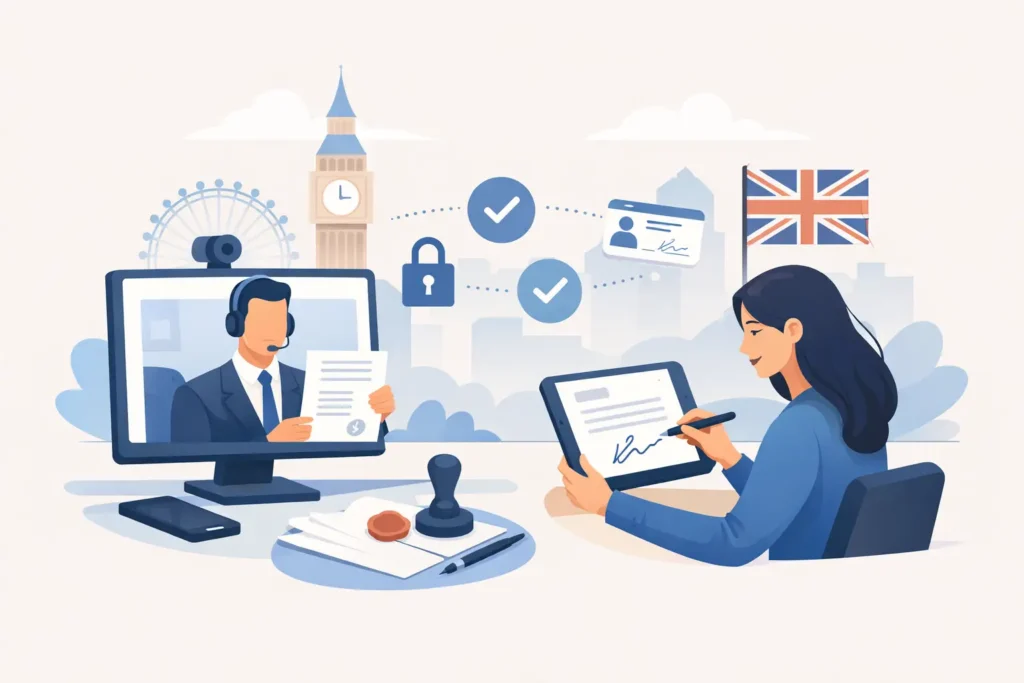
Remote notarisation is the process of a notary carrying out all or part of the notarisation procedure without the client being physically present in the same room. In practice, this usually involves identity checks, document review, and a video meeting rather than a face-to-face appointment.
The idea is straightforward, but the legal position is not always as simple as people expect. Notarisation often sits at the point where UK requirements meet the rules of another country, another institution, or both. A document may be prepared here, signed here, and still be rejected abroad if the receiving organisation expects a different form of witnessing or certification.
That is why the first question is not whether remote notarisation is convenient. It is whether it will be accepted for the purpose you need.
When remote notarisation may be suitable
Some matters lend themselves better to remote handling than others. If the core issue is confirming identity, reviewing supporting papers, and preparing the client properly before the document is signed, much of the work can often be done efficiently at a distance.
This can be particularly helpful for business clients managing cross-border transactions, directors who travel frequently, or individuals who are abroad, have limited mobility, or simply cannot attend an office easily. In some cases, a remote meeting allows the notary to review passports, proof of address, company documents, and draft papers in advance so that any problems are identified early.
There is also a practical benefit in timing. International matters often involve several stages – notarisation, legalisation, apostille requirements, translations, and submission to foreign lawyers or authorities. If part of the process can be handled remotely, it may reduce delay at the front end.
That said, suitable does not mean guaranteed. The real test is whether the document can be validly notarised in that way and whether the end user will accept it.
When remote notarisation is not enough
Many documents still require an in-person meeting. That may be because the notary must witness the signature physically, because the receiving country has stricter formalities, or because the circumstances call for closer scrutiny of the original papers.
For example, powers of attorney, affidavits, deeds, and documents involving capacity, vulnerable clients, or high-value transactions may require more than a video call. The notary must be satisfied not only as to identity, but also that the person signing understands the document, is acting freely, and is signing in the correct way. Where there is any doubt, face-to-face attendance is usually the safer route.
Original documents can also matter. A scan may be enough for a preliminary review, but some authorities insist on wet-ink signatures and original notarial certificates. If the destination country or receiving institution expects paper originals, remote handling may only solve part of the problem.
Why acceptance matters more than convenience
This is the point that catches many people out. A client may assume that if a document has been notarised, it will be accepted. In reality, acceptance depends on the organisation asking for it.
Foreign land registries, banks, courts, consulates, universities, and corporate registries do not all apply the same standards. Some are comfortable with digital processes. Others remain highly formal and expect traditional notarisation with original seals and signatures. Even within the same country, different bodies may take different approaches.
That is why a notary should ask what the document is for, where it will be used, and whether specific wording or formality has been requested. Those details are not administrative extras. They shape the entire process.
How the process usually works
Where remote notarisation is appropriate, the process normally begins with a review of the document and its intended use. The notary will want to see the draft document, understand the destination country, and check whether any supporting evidence is needed.
Identity verification comes next. This may involve a passport, driving licence, proof of address, and in some matters additional checks to establish source of authority, company role, or relationship to the transaction. If a company is involved, the notary may also need to review Companies House records, board minutes, or constitutional documents.
A video meeting may then be arranged to confirm identity, discuss the document, and assess whether the client understands what they are signing. This is not a formality for its own sake. A notary has professional duties that go beyond witnessing a signature. If the explanation does not add up, if instructions are inconsistent, or if there are concerns about pressure or misunderstanding, the matter may need further investigation or a different approach.
In some cases, the remote stage is followed by a final in-person signing. In others, the entire process can be completed without attendance, subject to the legal and practical requirements of the matter. It depends on the document and the destination.
Remote notarisation and fraud risk
One reason the law treats remote notarisation with care is the risk of fraud. Notarised documents are often used in high-value or high-consequence settings – international property transfers, company restructuring, probate matters, immigration paperwork, and cross-border authority documents. A mistake can be expensive. A fraudulent document can be devastating.
Remote identification tools can be effective, but they are not identical to examining an original passport in person or observing a signature first-hand. That does not make remote processes unreliable by definition. It does mean the notary must apply appropriate safeguards and professional judgement.
For clients, this is actually a point in favour of using an experienced notary rather than chasing the quickest appointment available. Speed matters, but so does getting the document accepted and avoiding later challenge.
The UK position in practical terms
In the UK, remote notarisation is not a simple yes-or-no service that applies uniformly to every case. The practical question is always whether the notary can properly complete the act and whether the receiving body will accept it.
That can feel frustrating if you are trying to arrange something urgently. You may want a direct answer straight away. But careful checking at the start usually saves time later. It is far better to confirm the requirements before signing than to discover, after legalisation or overseas courier costs, that the document has to be done again.
A client-focused notarial service should explain this clearly. You should know early on whether remote attendance is possible, whether originals are needed, whether further certification or apostille steps are likely, and what the likely timescale and fees will be.
What to prepare before asking about remote notarisation
If you are considering remote notarisation, it helps to gather the key details first. The most useful starting point is the document itself, the name of the country where it will be used, and any instructions from the receiving authority or overseas lawyer.
It is also sensible to have current identification and proof of address ready, along with any papers showing your authority to sign. For a business matter, that may include company details and evidence of your role. For a personal matter, it may include supporting documents that explain the background to the transaction.
The clearer the information at the outset, the easier it is for a notary to advise whether remote handling is realistic or whether a face-to-face appointment will be required.
Choosing the right approach
For some clients, remote notarisation is a genuine solution. It can reduce travel, speed up early checks, and make the process more manageable where time is short. For others, it is only part of the route, with in-person signing still needed at the final stage.
What matters most is not using remote notarisation for its own sake. It is choosing the method that gives your document the best chance of being valid, properly certified, and accepted where it needs to go. At White Horse Solicitors & Notary Public, that means giving practical advice at the outset, not after avoidable problems have already arisen.
If you need a document notarised, the safest first step is usually the simplest one – ask what will actually be accepted before you sign anything.
